Literature Review
Market Functions and Power Relations: Insights from Kirkgate Market
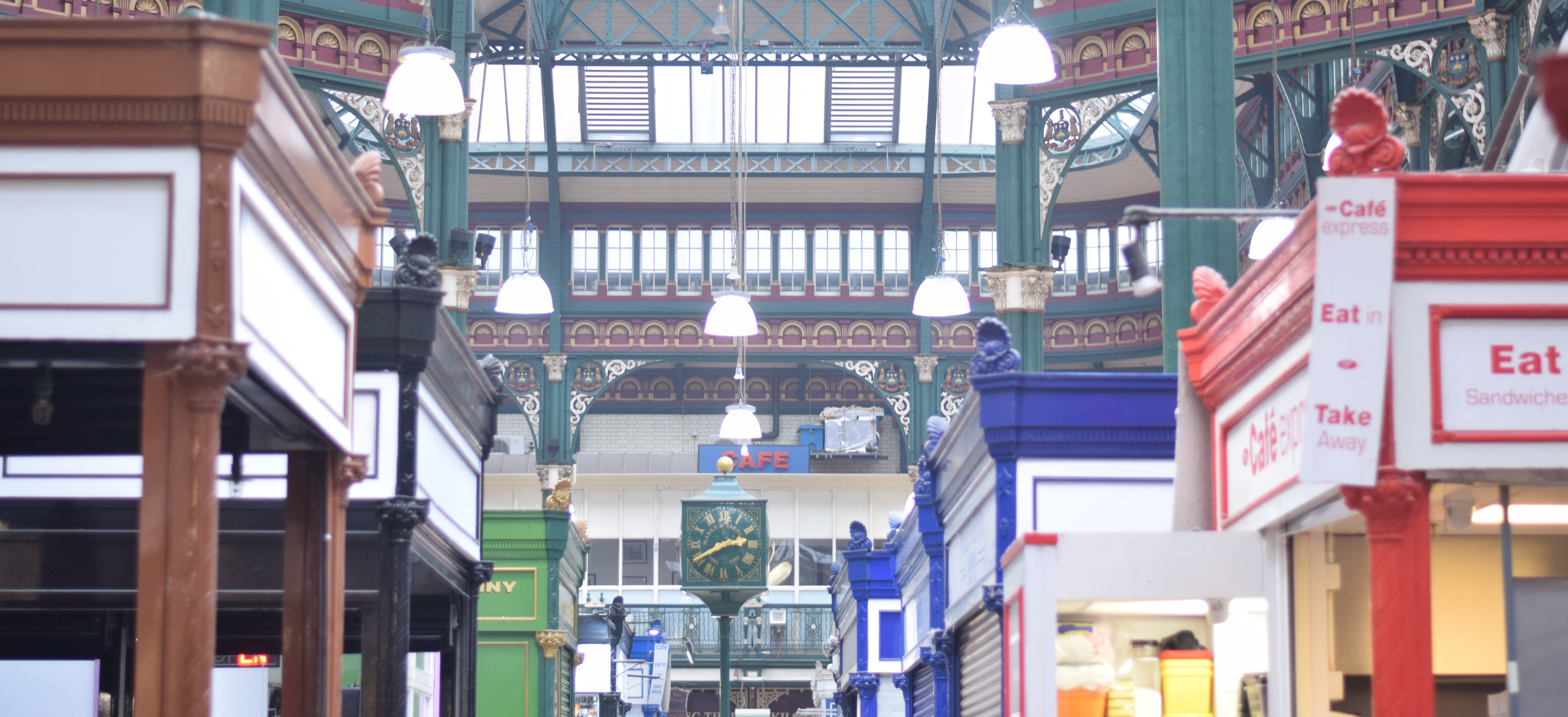
Markets are pivotal to economic activity, serving as platforms where goods, services, and ideas are exchanged. It also holds a significant place in urban landscapes, serving as hubs of economic activity and cultural exchange. This literature review aims to explore the multifaceted functions of markets, the entities controlling them, the diverse audience they attract, and the pivotal role individuals play in shaping changes within these vibrant settings; this will help us understand the dynamics of Kirkgate Market. With the evolution of markets, there has been a substantial body of literature exploring the concept of marketplaces and their significance in our society.
Before delving into the discussion of Kirkgate Market as a marketplace, it is essential to understand the concept of a market and its underlying dynamics. Marketplaces fulfil various functions which are important to local economies and communities. Firstly, they serve as venues for the exchange of goods and services, facilitating transactions between buyers and sellers (Schaefer, 2017). They also act as social spaces, fostering community interaction and cultural exchange (Wrigley et al., 2003) while preserving local traditions and heritage showcasing their artisanal crafts (Seyfang & Longhurst, 2013).
The distinctive functions of a marketplace also attract audiences with diverse needs and preferences. The audience is diverse including residents, tourists, entrepreneurs, and food enthusiasts. Residents rely on marketplaces for their daily shopping needs, seeking fresh produce, household goods, and specialty items (Chen et al., 2015). Tourists are also drawn to marketplaces for their authenticity and unique shopping experience which also contributes to the local economic development (Hospers, 2010). Entrepreneurs view marketplaces as platforms for testing new products and reaching a wider audience, fostering innovation and economic growth (Sharma et al., 2019) while food enthusiasts explore marketplaces for their culinary delights, trying out local delicacies and experiencing a new food culture (Long & Lyons, 2018). These individuals play a crucial role in driving changes within a market. The traders respond to these changes by diversifying, embracing technology, and engaging with customers through marketing initiatives. Additionally, community engagement and advocacy efforts can shape the development and revitalisation of marketplaces, ensuring they remain relevant and inclusive spaces for all (Evans et al., 2010).
Power dynamics in physical marketplaces are complex and multifaceted. Local authorities, market traders, and community groups all play important roles in shaping these dynamics. Regulatory bodies like Leeds City Council wield power through licensing and zoning regulations (Chatterton & Bradley, 2018). Market traders exert influence through their business practices and collective bargaining power (Crossick & Jaumain, 2011). Community groups may advocate for the preservation of cultural heritage or social inclusion, impacting market operations (Stebbins, 2017). Understanding these power relations is quite crucial in understanding the governance and functioning of physical marketplaces within urban environments.
Kirkgate Market
Kirkgate Market holds immense significance as a marketplace due to its rich historical heritage, vibrant cultural atmosphere, and role as a focal point for economic activity in Leeds.
Upon its inauguration in 1857, Leeds Kirkgate Market claimed the title of the largest indoor market in Europe (Leeds City Council, [no date]). Currently the Market hosts over 800 stalls and is also known as the birthplace of the well-known brand Marks and Spencer (Jones, 2023). Even though 2/3 part of the marketplace was destroyed by the fire the market reopened 3 days later and in 2013 the market underwent a £12 million renovation by Leeds City Council to modernise facilities and infrastructure (Leeds City Council, [no date]). Leeds Kirkgate Market hosts a diverse array of traders, many of whom are multi-generational and from various national backgrounds from Indians, Chinese, Asians to Persians! The market hosts an Asian Bazaar every Wednesday morning and a farmers’ market on Briggate every first and third Sunday of the month, further enriching its vibrant atmosphere (Leeds City Council, [no date]). Katie Ryrie (2021) called it “a place steeped in history but moving with the times.”
Despite its Victorian origins, Kirkgate Market has embraced modernization. It offers QR code booking for venues, available both online through their website and on-site. Additionally, most shops accept tap-and-pay transactions via card, ensuring convenient payment methods. Notably, the market features a cotton candy machine operated robotically, showcasing its commitment to innovation.
Despite Kirkgate's integral role in Leeds, there remains a dearth of literature regarding it. Existing literature tends to focus on architecture or semiotics rather than delving into market dynamics, power dynamics, or public perspectives within the marketplace.
Conclusion
In conclusion, the exploration of market dynamics, audience diversity, and power relations sheds light on the multifaceted nature of marketplaces like Kirkgate Market. These vibrant settings serve as economic and social hubs, fostering community interaction, cultural exchange, and economic growth. Despite its historical significance, there is a notable gap in literature regarding their intricacies, particularly in understanding power dynamics and public perspectives. As Kirkgate Market continues to evolve and modernize, further research into its governance, market dynamics, and societal impact is essential to fully grasp its significance within the urban landscape of Leeds.
References
Chatterton, P., & Bradley, P. (2018). Reshaping urban markets: Governing market activity for social, economic, and environmental gain. Routledge.
Chen, M. A., Sebstad, J., & O'Connell, L. (2015). Counting the invisible workforce: The case of urban street vendors in Thailand. World Development, 67, 1-14.
City Council Leeds. (no date) History of kirkgate market. Available at: https://www.leeds.gov.uk leedsmarkets/about/history-of-kirkgate-market (Accessed: 26 April 2024).
Crossick, G., & Jaumain, S. (2011). Cathedrals of Consumption: The European Department Store, 1850-1939. Ashgate Publishing, Ltd.
Evans, G., Shaw, P., & Ilbery, B. (2010). Marketing metropolitan excess: Cultural meanings, retail practices and sustainable development in out-of-town shopping centres. Geoforum, 41(1), 59-66.
Hospers, G. J. (2010). Place marketing in Europe: The branding of the Oresund Region. European Planning Studies, 18(1), 7-26.
Jones, I. (2023) Leeds Kirkgate Market - The Best Markets in Leeds, Creative Tourist. Available at: https://www.creativetourist.com/venue/leeds-kirkgate-market/ (Accessed: 27 April 2024).
Long, C. R., & Lyons, K. (2018). Culinary tourism. Lexington Books.
Ryrie, K. (2021) History and haggling in Leeds: Kirkgate market returns, Confidentials. Available at: https://confidentials.com/leeds/history-and-haggling-in-leeds-kirkgate-market-returns (Accessed: 27 April 2024).
Schaefer, A. (2017). Markets: A multidisciplinary analysis. John Wiley & Sons.
Seyfang, G., & Longhurst, N. (2013). Desperately seeking niches: Grassroots innovations and niche development in the community currency field. Global Environmental Change, 23(5), 881-891.
Sharma, A., Chhabra, D., & Rajput, N. (2019). Performance of entrepreneurs in street vending. Journal of Asia Business Studies, 13(4), 598-619.
Stebbins, R. A. (2017). The serious leisure perspective: An introduction. Routledge.
Wrigley, N., Warm, D., Margetts, B., & Lowe, M. (2003). The Leeds 'food deserts' intervention study: what the focus groups reveal. International Journal of Retail & Distribution Management, 31(3), 123-136.